Saturday, February 11, 2023

Dates of the 2023 ARC Europe. Let’s try this again, shall we?

  There is nothing like a global pandemic to teach you that all plans are tentative.  Yet here we are with another go at it.  

Leg 1: NJ to Annapolis, Maryland.  Departure: April 1, arriving April 5/7.

Leg 2: Virginia to Bermuda.  Departure:  May 1/2 arriving May 6/7.

Leg 3: Bermuda to Horta, Faial Azores.   Departure: May 17. 

Leg 4:  Azores Cruise with the rally.  June 3 through 10.

Leg 3a: Azores to Marina de Lagos, Portugal.  Departure: June 11.

Rally ends in Lagos, Portugal June 18th with Social Event and Ceremony.


Thursday, October 31, 2019

Preventing and Managing Seasickness

Hello All,

  I found the lecture notes from our Safety at Sea/Offshore Survival Training class instructor.  I will scan it and send it to whomever wants it.

  The following points are what John and I accepted as the bottom line:

 1) Each crew member should have an understanding of what medication works for them.  He said he does not allow anyone on his boat to go with the claim, “I have never been sea sick, therefore do not need anything”.  Experimentation with medications should occur before stepping onboard.  Pick a day when you can be home and try the medication to check out side effects.

  I appreciated this advice and how firm he was on the point since I was torn about whether to experiment with drugs or not.  Before this lecture I was one of those folks who believed since I have never been sick I never would be.  Growing up with my dad’s fishing boats, having been in 2 storms, one that repeatedly lifted his 65 ft Hatteras out of the water like a skiff,  being the one to go downstairs and make lunch....
BUT I know my turn is coming.
 
  I tried the patch and besides some dry mouth that forces me to drink water and stay hydrated it seems to work great for me and I have been in 4 heavy weather situations where I stopped to think, “I should really be sick right now, this med must be doing something”.

  John did not like the patch, prefers Dramamine all day less-drowsy.  Active ingredient: Meclazine.

2) The captain should know what medication you plan on using.  This sounds prudent to me.  If someone is loopy best that crew mates know what might be up.

3)  Use the medication for the first 2 to 3 days of a long passage.  The start of a voyage is not the time to miss a shift.

  Again, I appreciated this advice and he was very adamant about this.  He bragged that he has done over 10 ocean crossings and he has never had a sick crew member!  His point was better to have it in your system at the start then to attempt to take something if the need arises.
  We had the opportunity to see this.  We shared this advice with our Bermuda crew.  One chose to ignore it and he was sick, “for the first time!” one hour out.

Hope this sounds reasonable.


Friday, September 20, 2019

MOB - a work in progress


  As much as we love the “Figure 8 or Quick Recovery Method” that we did many times in sailing school...it is just not feasible with our sail arrangement.  With a 135% head sail and in-boom main....blowing the jib, quickly dropping the main and throwing the boom over is not possible or safe.
  John and I took a heavy weather sail class with John Neal in Alaska and he drove this point home with demonstrations on his own 46 HR.  Fortunately he has an alternative method that is also used by Annapolis Sailing School.

Here is the ROUGH outline:  Most of this is simultaneously going on so steps are just to help with memorization.

1) The spotter is still EVERYTHING!  Yell MOB!  Whoever is closest to the helm - Hit the MOB red button on the Chart Plotter.

2) Throw Stuff:  We have a Horseshoe Buoy on the starboard rail and type IV floatation cushions in the cockpit to throw overboard.
But the best thing to throw ASAP is in the Lifesling located on the port stern.  Inside the case is both  a Dan Buoy and the Life Sling.  Toss both.

3) Helmsman turns into the wind, slows the boat and starts the engine.  Next turns to circle the MOB dragging the Life Sling around the MOB.
There is also a MOB feature on our handheld VHF radios - if you are near one when you hear the call for help - press the button for 1 full second to activate the feature.

4) Crew simultaneously lowers main and furls in genoa sheets.  We can’t drop our head sheet, our Gennie takes time to furl.  At night I like sailing with the lines in position for lowering the main to save time whether there is a MOB or unexpected wind change.

5) Goal is to stop and catch the MOB amidship and have line connected before dragging MOB to transom swim platform.

6). If MOB is unconscious we have a sling onboard that allows us to lift a MOB with the main halyard.

PLEASE men!  The number one cause of MOBs is men peeing overboard!  So at night use a pee jug (I will happily provide a wide mouth Nalgene bottle) and stay in the cockpit!


Saturday, May 12, 2018

Inspecting Sea Dog's Liferaft

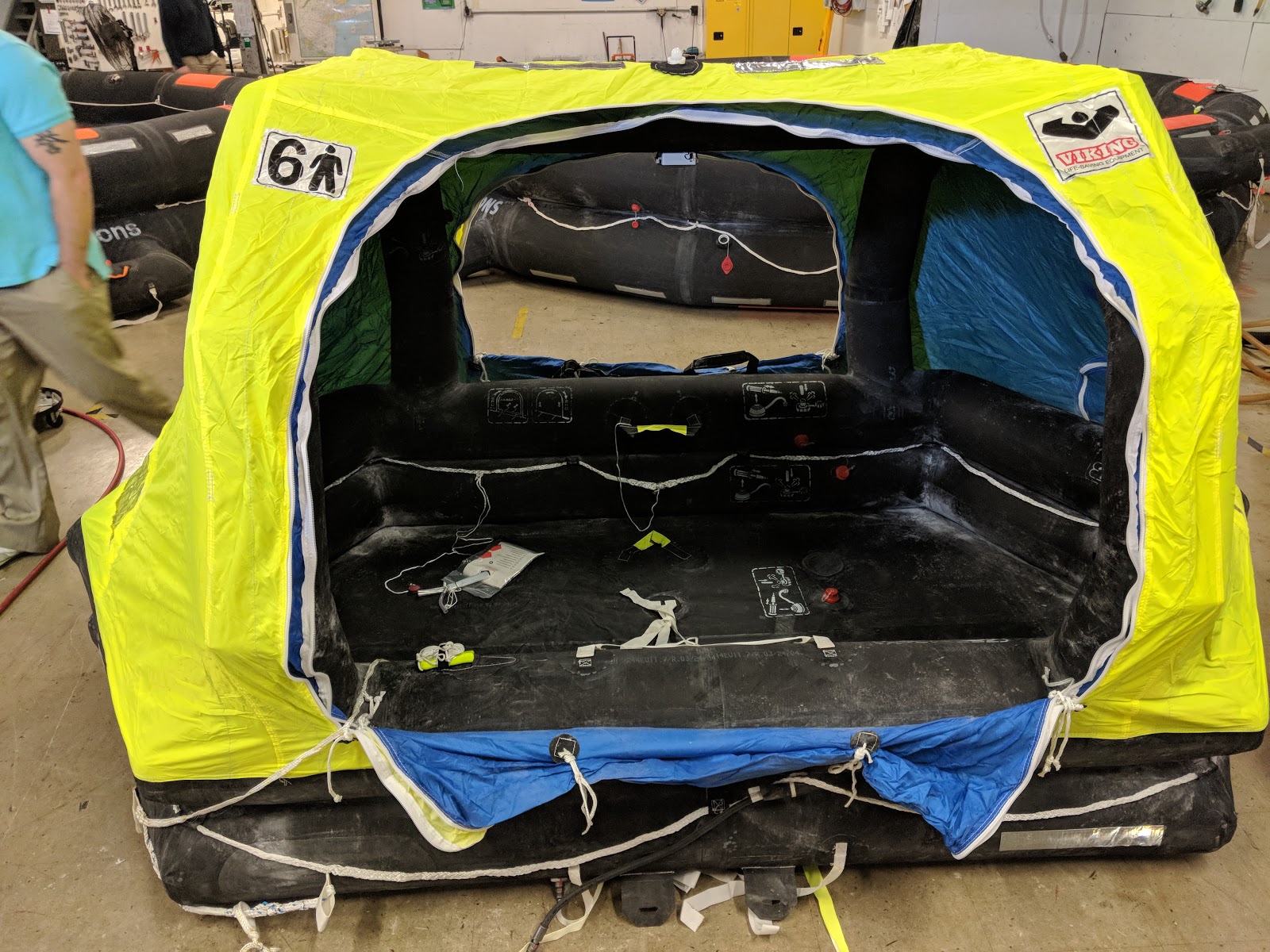
We just had the first service/inspection of our Viking 6 man Rescu Pro liferaft at Sea Safety International in Secacus NJ. It looks like it was in great shape after being inflated. Here are some photos:

The large opening is the primary rescue access and a secondary entrance. 

Michele checking out the primary entrance with a handy step.

It passed the inspection with flying colors!!  All of the expired items have been refreshed. We are hoping this is the only time we ever see our liferaft inflated, on the inspection floor.

Friday, May 11, 2018

Resources and Miscellaneous


What To Bring:  Quantum Sails - under articles:  “How to pack like a pro for an ocean crossing”.

Thru hull Diagram.  We have copies in 2 places on the boat: 1) Attached to the underside of the Nav Desktop. 2) Inside the cabinet door of the forward head.  ALL thru hulls have a plug on a string attached to the base of the seacock valves.